Thai Yoga Massage in Bielefeld On the floor, in comfortable clothing, without oil
Thai Yoga Massage (Nuat Phaen Boran) combines rhythmic pressure along the energy lines with passive stretches from yoga. I work with my hands, thumbs, forearms, knees and feet. You don’t have to do anything; your body follows. In my massage room in Bielefeld we take 75 to 120 minutes for this.
What is Thai Yoga Massage?
Thai Yoga Massage is a traditional form of bodywork from Thailand. It combines Thai massage techniques, acupressure and stretches reminiscent of yoga. You lie on a soft mat on the floor in loose clothing, without any oil.
I work with slow, precise pressure along the energy lines, called sen or nadis in the Thai tradition. Rhythmic movements and stretches are added. Subtle, slow touch alternates with clear, strong movements. I notice where you follow along and what your body needs in order to let go.
Perhaps you know from yoga how good stretching feels. The same happens here, except that you don’t have to do anything.
Why often the whole body?
Much in the body is connected: tension in one place often shows up somewhere else. That is why I usually work on the whole body, even if it is mainly your neck or back that bothers you. If that is exactly what you are looking for: Thai Yoga Massage for back and neck.
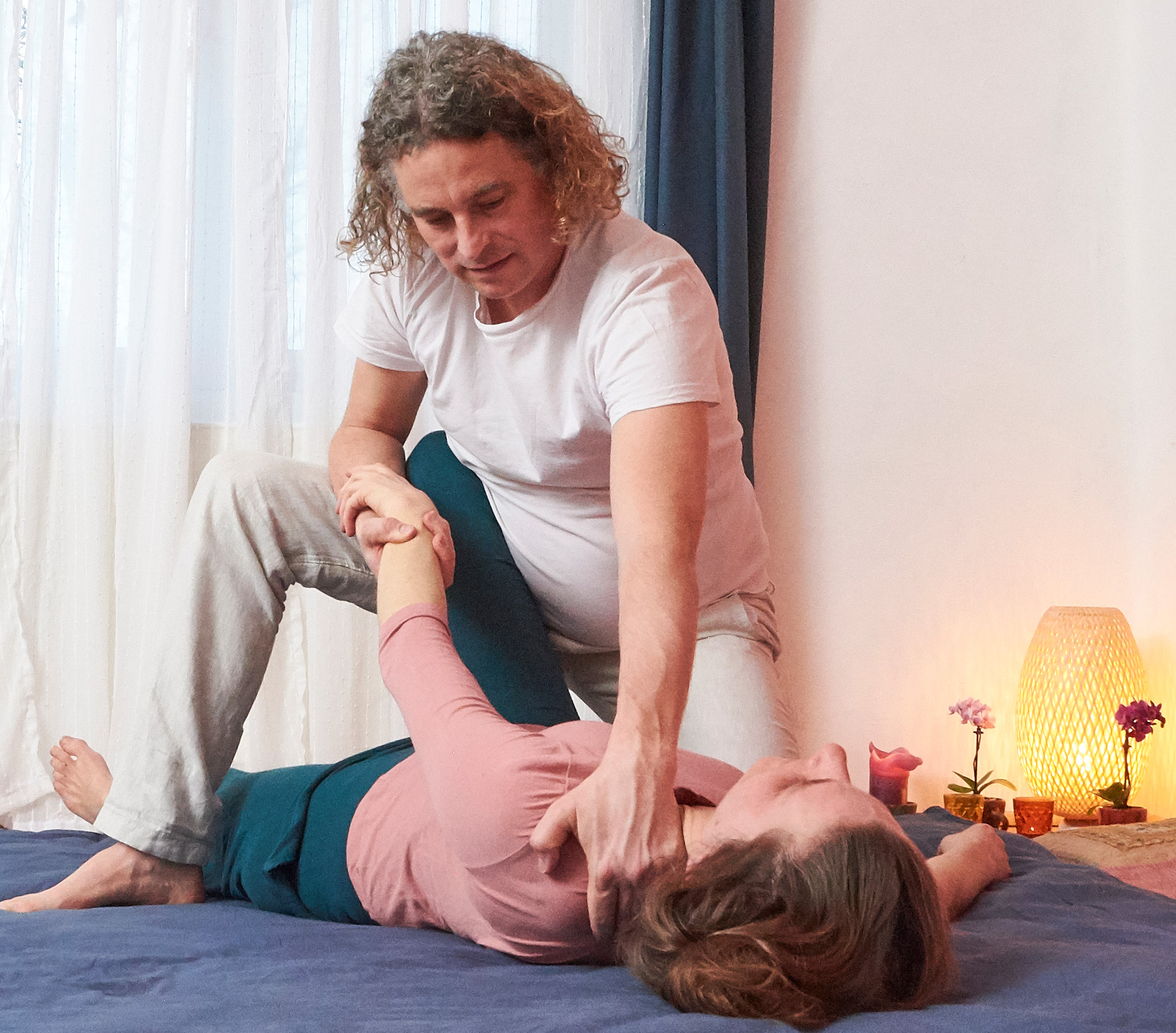
What goes into a session
Traditional Thai Massage
Nuat Phaen Boran: calm, even pressure along the energy lines, combined with stretches. The foundation of every session.
Dynamic Thai Massage
After Thai Master Chaiyuth Priyasith: swinging, shaking, flowing movement. The body is brought into rhythm and lets go without you having to do anything.
Osteothai
Thai massage meets osteopathic thinking: slow, listening, with a fine sense for joints, fascia and breath.
From the second trimester I work in side position, calmly and without strong stretches. Same prices as all sessions.
Arrive, let go, feel
-
01
Arriving
We talk briefly about how you are and what you would like. Then you lie down on the mat in comfortable clothing.
-
02
Pressure and rhythm
I begin at the feet, slowly and mindfully. The pressure deepens, as much as feels good to you.
-
03
Movement and stretching
Swinging, shaking, stretching. Your body follows the movements, you don’t have to do anything. Not too strong, not too weak.
-
04
Resting
At the end, time to lie and feel. Take what you need before you return to your day.
For everyone who wants a break from everyday life
You don’t need any previous experience or special flexibility. I adapt pressure, pace and stretching to you. Tell me beforehand what you need, and during the session if something should be different.
What guests often tell me afterwards
- The muscles feel softer.
- The mind becomes calmer.
- Movement feels freer.
- The breath becomes deeper and calmer.
- A sense of warmth and groundedness throughout the body.
Thai Yoga Massage is bodywork for relaxation and wellbeing. It does not replace medical or therapeutic treatment.
If you have acute injuries, recent surgery, fever, are pregnant or have existing conditions, please talk to me before your appointment.
A tradition more than 2,500 years old
Its roots go back to northern India. The physician Jivaka Kumar Bhaccha, known as Shivago, a contemporary of the Buddha, is considered its founder. With Buddhist monks the massage travelled to Southeast Asia, where it was passed down orally in temples for centuries. In Thailand it is called Nuat Phaen Boran; in the West it is known mainly as Thai Yoga Massage. To this day it carries the four Buddhist attitudes within it: loving kindness, compassion, sympathetic joy and equanimity.
Since the 1990s it has also been taught in the West, made known among others by Asokananda. Here, gentle and compassionate work takes centre stage: without hurry, working with gravity rather than force. In Thailand things can occasionally be rougher. I stay within your comfort zone, because only when you feel safe can your body truly let go.
You can find more background on energy lines, ways of working and history on my blog thai-yoga-massage-bielefeld.de (in German).
What you’d like to know beforehand
Something missing? Write to me or call: +49 521 44811261.
What should I wear?
Comfortable, stretchy clothing, for example jogging trousers and a T-shirt. The massage takes place without oil and fully clothed.
What is the difference between Thai massage and Thai Yoga Massage?
It is the same bodywork: Thai Yoga Massage, traditional Thai massage and Nuat Phaen Boran mean the same thing. In the West it is usually done more gently and slowly than in many massage parlours in Thailand. With me it takes place on a mat on the floor, not on a massage table.
How long is a session and how much does it cost?
75 minutes cost €100, 90 minutes €115 and 120 minutes €140, each including an initial conversation and resting afterwards. For a first visit there is a one-off 60-minute session for €80. Reduced prices are available for students and people on a low income.
Do I need to be flexible?
No. I adapt every stretch to your body. You don’t have to do anything actively; your body follows the movements.
Does Thai Yoga Massage hurt?
No, it should feel pleasant. The pressure increases slowly, but only as much as feels good for you. Tell me at any time if you would like more or less.
How is this different from a classic massage?
Thai Yoga Massage takes place on a mat on the floor, without oil and fully clothed. Instead of only kneading, I work with pressure, stretching, movement and rhythm, often using my whole body.
How often should I come?
Many people come every four to six weeks, others once a quarter. The 5-session package is for everyone who would like to come regularly.
What do Dynamic Thai Massage and Osteothai mean?
Dynamic Thai Massage after Thai Master Chaiyuth Priyasith works with swinging, shaking and flowing movements. Osteothai combines Thai massage with approaches from osteopathy: slow, listening, with close attention to joints and tissue.
How does the abdominal massage work?
The abdominal massage after Kerys Williams works mindfully and slowly on the belly while you lie on your back. It can be part of a session or its main focus. Please don’t come straight after a large meal.
Ready to let yourself fall?
75, 90 or 120 minutes. Bookable online, free cancellation up to 24 hours before.
Choose your appointment